Apps XReadyLab VR Physics: Lenses Lab
Learning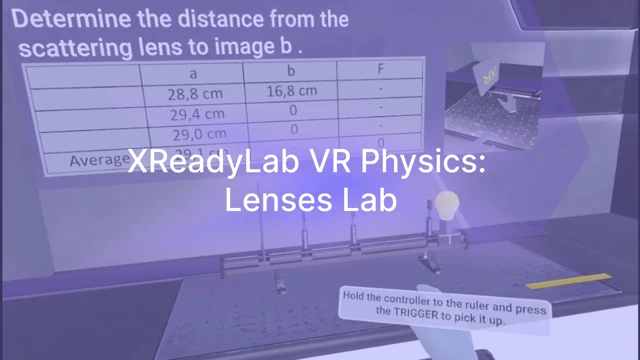
What students do in VR:
Build optical systems using converging and diverging lenses
Adjust object distance and lens position → observe changes in image formation in real time
Measure object distance (u) and image distance (v) → calculate focal length
Modify lens configurations → observe image clarity, size, and orientation
What students learn:
Image formation by lenses (real and virtual images)
Focal length and its relationship to object and image distance
Lens formula and optical calculations
Behavior of converging (convex) and diverging (concave) lenses
Relationship between lens position and image properties (size, clarity, orientation)
For Schools
Aligned with IB, NGSS, TEKS, College Board, Cambridge, CBSE, and other international curricula.
Includes:
Ready-to-use Lesson Plans and Engagement Playbooks
Structured guidance for VR lesson implementation:
Before, during, and after simulation activities
Group organization and classroom integration
Reflection questions, analysis tasks, and problem-solving exercises
Practical assignments and assessment tools
Troubleshooting checklist for technical issues
Supports both classroom use and independent home learning.
Age Range & Level:
Designed primarily for High School
Can also be used in Middle School as an advanced or enrichment tool
| comfort | ⦾ Moderate |
| age rating | 0+ Everyone |
| storage | 0.5 GB |
| website | xreadylab.com |
| developer | XReadyLab |
| publisher | XReadyLab |
| connection | Internet not required |
| app version | 2.1.2 |
| languages |
English
|
Price History
- base price $9.99 from Mar 26
- - no discounts